The Winding Cloth
Posted on | May 14, 2013 | 1 Comment
The electronic revolution increasingly knits us all on planet Earth into a common consciousness, a common memory. It also makes possible an increasing degree of empathy across the barriers of race, class, language, geography, and religion. We suffer together even as we hope together. As the horrific death of over a thousand people in the recent collapse of the textile factory in Bangladesh pulsed into our lives, we were both in pain at the carnage and elated by the survival of one courageous woman.
In this world of instant communication we are bound in one cloth, one body, whether it is in breathing the polluted, heat-trapping air, eating the dwindling fish from the acidifying oceans, weeping with the people of Newtown, or struggling with our response to fellow human beings in conflict in Congo or Syria. The sense of mutual entanglement and obligation can suffocate us in guilt or anxiety. It can also give us a renewed sense of collaboration, of mutual inspiration, and common humanity.
It is against this deep sense of our implication in this common web of suffering, mutual obligation, and hope that I share this poem, which emerged as my response to the events in Bangladesh.
Audio clip: Adobe Flash Player (version 9 or above) is required to play this audio clip. Download the latest version here. You also need to have JavaScript enabled in your browser.
Bangled on our shoulders
wrapped around our waists
arms
legs
the cloth
winds over seas
and swamps
and mountains
packed in planes and ships
and trains and trucks,
stitched in darkened sepulchers of toil
dust filling air and lungs
the din cascading into ears
the sweat down backs and legs
into a distant bank account,
the yearning for a better life
turned into screams
beneath the fallen concrete slabs.
“That’s beautiful,
your shirt,
where did you get it?”
“Oh, so cheap?”
The Winding Cloth
Precious Cargo: Creation Flower
Posted on | May 6, 2013 | 4 Comments
When Sylvia and I were planning our recent visit to South Africa, a garden committee at nearby Lake Junaluska Retreat and Conference Center asked if we might select, purchase, and arrange for shipping of a stone sculpture suitable for their Welcome Center’s “Biblical Garden.” When Sylvia had overseen the art for the Welcome Center at its construction some six years ago she had envisioned the presence of one of the stunning pieces developed by the Shona sculptors of Zimbabwe. We knew of a place that sold Shona sculptures near Cape Town and said we would take on the assignment.
We were first captivated by this artwork when we visited the magnificent Kirstenbosch Gardens outside Cape Town in 1998 to see an extensive exhibition of pieces created in the Chapunga workshops in Zimbabwe. Their spiritual depth and human immediacy affected us deeply and have found enthusiastic reception around the world.
When we got to South Africa we visited the extensive sculpture center, “A
Little Piece of Africa,” on the road to Cape Point and were helped by Anna Mutize, daughter of the founder, who goes back to Zimbabwe regularly to select works for sale in Cape Town. We settled on a relatively small piece (only 100 pounds) entitled “Creation Flower,” that seemed just right for the garden. It was carved from serpentine by Naboth Chandiringa. Sylvia then carried on an extensive correspondence with the shipper in Cape Town to arrange for its crating and transport. Intimidated by the procedures, rules, and routes this precious cargo would take, we were grateful for his experienced counsel to these utter novices.
When we finally received word of its shipment, we tracked its progress through the air and on the ground to Charlotte. We then drove to the airport freight complex to get the wooden crate. Weaving our way through the labyrinth of warehouses and semi-trailers, we found our way to the shipper’s office. The clerk who responded to our bell at the desk said cheerily, “Oh, you must be Sylvia.” She patiently explained that “No, we don’t take checks, cash, or credit cards. You get a money order from the post office around the corner. Then come back.” And then, “Find your way to the customs office.” And then submit your papers. And then wait. And then try to explain that the stone sculpture listed as “opal” is not a huge gem but a kind of stone called serpentine. Tell the Customs officer, “This is all a mystery to us” and hear him say, smiling, “We like to keep it that way.” Stamp! Stamp! Stamp! And then, famished, stop at the nearby recommended Mexican restaurant. And then return with stamped papers to our friend at the warehouse. And then drive up a ramp beside the massive trucks and petition a forklift driver to get the crate. It comes, with ceremony, on his massive forklift. After all the bar codes, forms, and papers, the crate simply said in handwriting on its top, “Sylvia Everett.” Our experience of receiving it became the poem you can read and hear below.
It now sits in the garden, anchored to a boulder beside a water feature and a cascading redbud. I think it will find new friends and family here, far from its ancient origins and the hands that gave its inner spirit new birth.
Audio clip: Adobe Flash Player (version 9 or above) is required to play this audio clip. Download the latest version here. You also need to have JavaScript enabled in your browser.
On the forklift
sits a dark bronze Buddha
from ancestral Africa
smiling
from his throne.
He takes my paper
scans it searchingly
drives off among the rows
and rows
of crates and packages
within the hollows of the terminal.
I wait
in silence
at the ramp
dwarfed among the semi-trailers,
car trunk yawning open
ready for its precious load.
Out of darkness
he returns,
the forklift bearing like a sleeping child
the object of my search.
I kneel amazed
to touch the box
inspect its face
see my name
upon the label.
I hear a voice beside me gruffly ask
“Is this the AirSpeed terminal?”
The Buddha smiles,
still cradling the box
between the massive fingers of his forklift,
“Down to your left two blocks and round the corner.
Right church, wrong pew.”
He lowers the long-awaited cargo
to my feet.
Tags: Lake Junaluska Conference and Retreat Center > Shona Sculptures
Singing the Words
Posted on | April 24, 2013 | 3 Comments
For many of us, the source and power of poetry lies in its oral performance. It is first of all an oral and auditory medium. Indeed, this power of the spoken word is recognized in our major religious traditions. The Qu’ran means literally “the recitation.” Christians and Jews still approach the Bible in worship by having it read aloud. This is not merely an archaism from a time when most people could not read, but a testament to something powerful that goes on when words are spoken and heard. Something goes on in us that makes them more “real.” Part of this may even be physiological. Part of it is certainly that speaking and hearing already require two persons, thus creating the beginnings of community and the possibility of the relational virtues of love and justice. Indeed, well-crafted poetry deepens our capacity for empathy and imagination of other possibilities in life — two capacities underlying the Golden Rule at the heart of our ethics. Poetry is the arrangement of words aimed at maximizing this auditory and social power. In that sense, poems are first of all the texts for songs. Indeed, long after other mental faculties fall away, it is the songs that still ripple in our brains and consciousness.
Granted, there is still power in a silent reading of words in our solitude. But this dialogue within the self, giving rise to our preoccupation with our inner thoughts and feelings, arose only slowly in antiquity. Plato’s philosophy was written as dialogues. St. Augustine recounts with some amazement in his Confessions (themselves written as a prayer to God) how his mentor, Bishop Ambrose, read silently, without moving his lips. The spoken word, made more hearable and memorable by its poetic composition, is both the vehicle of sociality and, as I think Muslims would most affirm, the door to prayer. It is also a primary basis of vital public life. This is why the oral presentation of words in religious and public settings requires real training and attention to the power inherent in words and their auditory composition.
While much of my poetry is very personal (is not all good poetry thus?), it is not private. The very act of putting something personal into poetic form is an act of going public. This is why poetry that struggles to be intricate and puzzling simply to display mental or linguistic virtuosity seems to me to miss the mark. While some of my poetry is simply having a good time with words, meanings, and sounds, I constantly return to the value of public connection through the spoken poetic word.
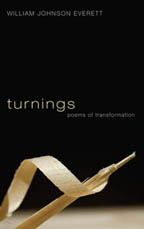
Poet Kathryn Stripling Byer commented about my poems that they seem to be “…on the brink of turning into nothing less than song itself.” This, at least, is the value I aspire to. In this light, an enormous gift was sent to me by Robert Steiner, a theologian and Pastor of Rondebosch United Church in Cape Town, who is also an accomplished singer and songwriter. He has taken some of my poems and set them to some accompaniment to amplify their meaning and depth as oral creations. He has given me permission to share them here – first, the words as they appear in Turnings: Poems of Transformation, and then Robert’s musical composition of them. The first is entitled “Between,” the second “A Single Thread.” (Depending on your computer, you may need to wait a few moments for “buffering” after clicking on the audio icon.)
There is a space between chapters,
a crack in the spine.
Two pages meet
and disappear
into a hidden abyss
where they are sewn invisibly together.
Audio clip: Adobe Flash Player (version 9 or above) is required to play this audio clip. Download the latest version here. You also need to have JavaScript enabled in your browser.
A single thread
in the cloth bag
holding our treasures
breaks.
Our glistening marbles,
photographs of younger smiles,
address books,
journals of our inward thoughts,
slip through
the widening tear.
We fall
with them,
wondering
if loving hands will catch us.
Audio clip: Adobe Flash Player (version 9 or above) is required to play this audio clip. Download the latest version here. You also need to have JavaScript enabled in your browser.
Tags: Robert Steiner > Rondebosch United Church > St. Augustine
Mine Ear
Posted on | April 4, 2013 | No Comments
We have just passed through another week we Christians call “holy,” not because other time is not holy, but because we seek to use this time to listen more deeply to the suffering and healing presence of God in these days. Indeed, we seek to comprehend our own suffering and death as well as that around us, hoping to see the Light more clearly. In that respect, I was struck by a desire to rename “Good Friday,” whose “goodness” depends on accepting the theory that Jesus had to die to settle scores with God, his “Father,” thus erasing our sins from the Divine ledger. He did good, dying. Rather, it would help me simply to recognize it as a day of co-suffering – with ourselves, our fellow humans, the earth, and God.
We were especially fortunate to have a dramatic thread through the week crafted by our friend and author Angela Dove and enacted by poet Michael Beadle, counselor Ned Martin, and actress/singer Lyn Donnelly. Among all the familiar themes and words from these events, a minor note stuck in my mind, resonating and clamoring for recognition. It is the moment when one of the disciples (Peter, says the Gospel according to John) cuts off the ear of the slave of the high priest. (Again, John alone names him.) Somehow, this became a way into the story for me.
Like so many of my poems, tangling as they do with the richness of the English language, it revolves in the end around a play on words. It is, however, a bilingual pun, hearkening to the Dutch that found its way to the Afrikaans spoken at the Cape of Good Hope. But I’ll leave that to the end, where I place the titles of my poems.
Audio clip: Adobe Flash Player (version 9 or above) is required to play this audio clip. Download the latest version here. You also need to have JavaScript enabled in your browser.
Mine ear!
Cut off
beneath the olive trees
by tempered
sword,
by cudgeling
crowds,
That fisherman
from Galilee
he sliced it off
me
Malchus
bound in silent servitude,
mine ear that listened for commands
from priestly powers
yes, my priest,
my high priest.
Now blinded by the pain
no way to hear commands
to listen to the rooster crow
the jingle of the coins
the creaking rope
earth’s agony,
But healed by the rabbi’s hand
I hear beyond
the sword
the priest
the crowd
sepulchral groans.
I stand
within a clearing
free to hear
the silence
saving words.
Mynheer
“Mynheer” is the Dutch/Afrikaans for “my Lord.” The Gospel source is John 18:10.
keep looking »


wood upon a lathe, these poems are word-turnings that reveal the inner grain of our human experience. They are bowls to catch our turnings of memory, conversion, falling in love, and passing through our seasons and the wrenching turns that mark our lives. Above all these turnings are a shout of praise, a murmur of wonder, a turning away from life as usual, a merciful re-turning to the songs, images and stories that move our lives.
Red Clay, Blood River